


I hadn’t surfed in 12 years when I paddled out in Nosara. Turns out twelve years is nothing, because I was up on my first wave and everything came back at once: the weight of the board, the way the water feels different when you’re in it, the timing that lives in your body and not your head. I loved it just as much as I ever had.
Two weeks later I was back in the water in San Clemente with my two daughters. I’d put them in surf camp for the week, watching them from the sand each morning, delighted and a little proud in the way you are when your children discover something that also belongs to you.
By the end of the week, Gabrielle, my oldest, who is 11, had taken to it like a seasoned pro and was paddling out beside me.
I want to try to explain what that felt like, because it was one of those moments that doesn’t fully resolve into words. She has been watching me her whole life. Watching me be a doctor, a mother, a woman moving through the world with intention and sometimes with exhaustion. But she had never seen me surf, and there we were, side by side in the water, equally confident, equally at home, both of us reading the same waves. For a stretch of time out there, I genuinely forgot she was only 11. She felt like a peer, two women, two friends in the ocean doing something we both loved.
And then I caught a wave she tried to follow me onto. It was too big for her, and she was too far forward on her board. She nose-dived, the board shot straight up into the air, and when she surfaced, another wave was already coming. She didn’t have time to get her bearings before it hit and she went under again. My husband was standing on the shore with his camera and caught the whole thing, which is its own kind of gift, because now we have footage of what I’m about to describe.
She was caught in the break zone.
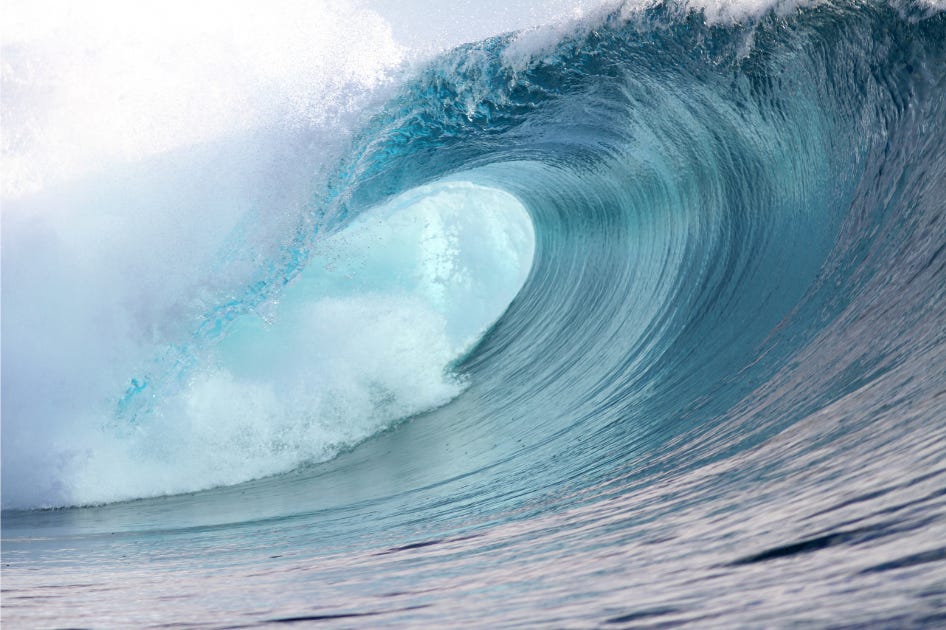
If you’ve ever been in open water during a set, you know what the break zone feels like. It’s the stretch of ocean where the waves are breaking rather than rolling, where the water is churning and white and loud, and where getting through to calmer water requires either perfect timing or sheer determination. It is not dangerous if you know what you’re doing, but it is relentless. You surface, and before you can fully catch your breath, another wave is already on top of you. It doesn’t give you a moment to collect yourself. That’s the nature of it.
Gabrielle went under a couple more times, and I could see that she was starting to panic. Then something shifted. I could see it from where I was in the water: she stopped fighting it and started moving through it. She found her board, pulled herself up on top of it, and rode the whitewater in toward shore. When she got close enough to stand, she looked back at me, and I could see she’d been crying.
“I’m done, Mom. I’m going in.”
I said okay, and I meant it without reservation.
She didn’t ask permission or look at me to gauge whether I was disappointed or whether she should try again. She named what was true for her in that moment, clearly and without apology, and she acted on it. Eleven years old, salt water on her face, still catching her breath, and already in possession of something that takes most women decades to find their way back to: the knowledge of when she’d had enough, and the trust that this knowing was real.
I think about how many women I’ve sat across from in clinical settings and in coaching who have lost access to exactly that, not because they were weak or because something was wrong with them, but because they were taught, gradually and systematically, to override it. To push through. To question whether what their body was signaling was real or just discomfort they could manage if they tried a little harder. To treat every internal “I’m done” as something to be reasoned away rather than honored.
The break zone for so many of the women I work with isn’t a stretch of ocean. It’s a season of life. It’s the years of doing everything right and still feeling like you’re being tumbled. Therapy, protocols, breathwork, supplements, all of it good, all of it real, and still that feeling of surfacing just long enough for the next wave to hit before you’ve caught your breath.
The relentlessness isn’t a sign that you’re failing. It’s a sign that you’re in the break zone, and what you need isn’t more effort. What you need is to find your board, get on top of it, and let it carry you to shore.
That’s what the work of healing actually looks like: not the dramatic breakthrough, but the quiet moment where you stop fighting the water and start moving through it. Where you find the thing that will hold you, and you let it. Where you trust yourself enough to say “I’m done” and mean it without apology, and then stand on solid ground and decide what comes next from there.
Gabrielle is already talking about going back in next summer. In fact, she’s been begging me to plan a trip this fall. She talks about it casually, like it’s obvious and certain, because for her it is. She went into the break zone, she got through it, and it didn’t take anything from her that she hasn’t already started rebuilding.
That’s what happens when you honor your limits instead of abandoning them. You don’t lose the ocean or your capacity. You just come back to it on different terms.
The principles I build my work around- love of self, vitality, health, and healing- aren’t abstract concepts. They’re exactly this. The moment you stop treating your own signals as inconvenient and start treating them as intelligent. When you understand that knowing when you’ve had enough is not a failure of resilience but an act of it. And finally, realizing that getting to shore so you can decide what’s next is not giving up on the ocean. It’s how you make sure you can come back to it.
Be well. Be fierce. Be lavish.